
Many people who enjoy casino games eventually hear about something called a betting system. These systems promise a simple idea. By following a pattern of bets, a player might believe they can overcome the casino advantage.
Some systems suggest raising a bet after losing. Others recommend lowering a bet after winning. A few systems ask players to follow long patterns of numbers and precise timing.
At first these ideas can sound convincing. They appear logical and organized. A person might feel that using a clear system brings more control to a game that normally depends on chance.
But there is an important truth behind every casino game.
Betting systems do not change the mathematics of the game.
They may create the feeling of discipline and structure, yet they cannot remove the advantage that belongs to the casino. To understand why, we need to look at probability, statistics, and how casino games actually work over time.
Why Betting Systems Feel So Convincing
Human beings naturally enjoy patterns. Our minds are built to search for order in events that appear random.
When people see unpredictable results, they often try to create rules that make outcomes feel more manageable.
Betting systems provide exactly that.
Instead of placing random bets, the player follows a plan. The plan tells them what to do next after every win or loss.
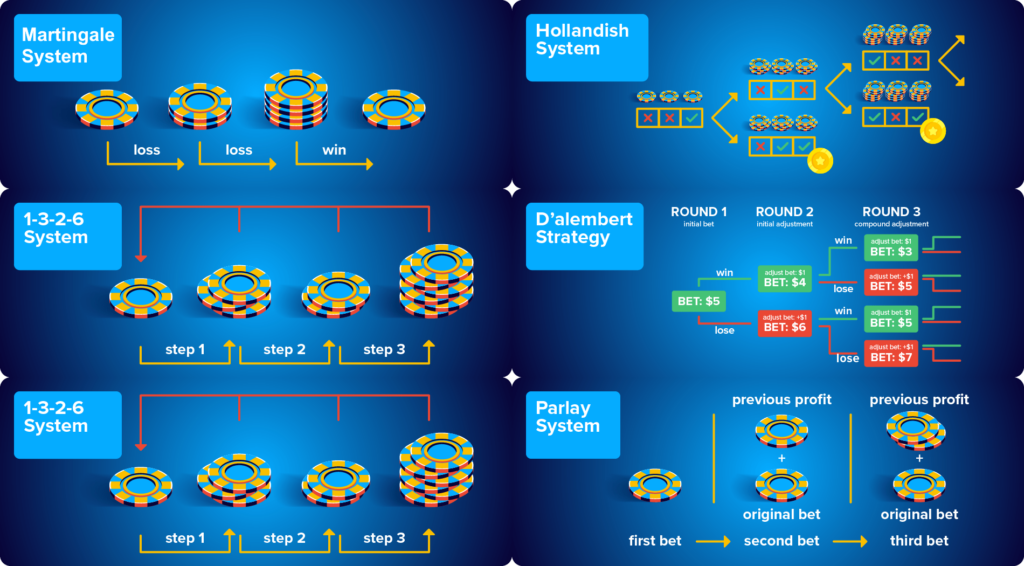
A famous example is the Martingale System. In this system, the player doubles the bet after every loss.
For example:
| Round | Bet | Result | Next Bet |
|---|---|---|---|
| 1 | $5 | Loss | $10 |
| 2 | $10 | Loss | $20 |
| 3 | $20 | Win | Reset to $5 |
When the win finally happens, the player recovers all previous losses and earns a small profit.
This moment can feel powerful. The system appears to have solved the problem of losing streaks.
Another popular strategy is the Fibonacci System, where bets follow the Fibonacci number sequence.
Players believe these systems help control risk and create consistent profits.
But there is a problem.
The probabilities of the game never change.
The House Edge Still Exists

Every casino game contains a built in advantage for the casino called the house edge.
The house edge is the average percentage of each bet that the casino expects to keep over time.
For example:
| Game | Typical House Edge |
|---|---|
| Blackjack (basic strategy) | about 0.5 percent |
| European roulette | about 2.7 percent |
| American roulette | about 5.26 percent |
| Slot machines | about 3 to 12 percent |
This means if $100,000 is wagered on a game with a 5 percent house edge, the casino expects to keep about $5,000 over time.
Betting systems cannot change this number.
They only change how much money is bet each round.
In simple terms, this law says:
As the number of trials increases, the average outcome moves closer to the expected probability.
Even if players win during short sessions, the long term results gradually move toward the mathematical expectation.
Betting systems do not stop this process.
Example Using Roulette
Consider a simple example using Roulette.
In American roulette there are:
- 18 red numbers
- 18 black numbers
- 2 green numbers
Total slots: 38
Probability of red:
18 / 38 = 47.37 percent
Probability of losing on red:
20 / 38 = 52.63 percent
This difference creates the 5.26 percent house edge.
Now imagine two players.
Player A bets randomly.
Player B uses a betting system like Martingale.
Both players face exactly the same probabilities on every spin.
The wheel does not care about their strategy.
Visualizing Roulette Probabilities
Every spin of the wheel is independent.
The wheel does not remember previous spins. This principle is known as independent probability events.
Even if red appears five times in a row, the chance of red on the next spin remains exactly the same.
The Hidden Risk Of Increasing Bets
Many betting systems depend on increasing the bet after losing.
This creates a dangerous situation.
Losses can continue longer than expected.
Let us look at how quickly bets grow in a Martingale system starting with $5.
| Loss Streak | Required Bet |
|---|---|
| 1 | $10 |
| 2 | $20 |
| 3 | $40 |
| 4 | $80 |
| 5 | $160 |
| 6 | $320 |
| 7 | $640 |
| 8 | $1,280 |
After just eight losses in a row, the player must bet $1,280 to continue the system.
Losing streaks like this are not rare.
In fact, in games like roulette they happen regularly over long play sessions.
Table Limits Stop Betting Systems
Casinos understand how betting systems work.
That is why they introduce table limits.
For example:
- Minimum bet: $5
- Maximum bet: $500
If a Martingale player reaches the $500 limit, they cannot double the bet anymore.
At that point, the system breaks down.
This rule protects the casino and prevents players from escalating bets indefinitely.
Real Player Experiences
Casino forums are full of players discussing betting systems.
One player wrote:
“Martingale works until the day it doesn’t. That day usually wipes out weeks of small wins.”
Another player shared:
“I followed a system for months and felt like I cracked the code. Then one long losing streak erased everything.”
These comments reflect a common experience.
Betting systems often produce many small wins but occasional large losses.
Statistical Evidence From Simulations
Researchers have simulated thousands of betting sessions using systems like Martingale.
The results consistently show the same pattern:
| Outcome Type | Frequency |
|---|---|
| Small profits | Common |
| Break even sessions | Moderate |
| Large losses | Rare but severe |
Over long periods, the house edge still dominates.
Even when players follow strict systems, the average return eventually reflects the mathematical advantage of the casino.
Why Betting Systems Still Exist
If betting systems do not work, why are they so popular?
There are several reasons.
They Provide Structure
Players feel more disciplined when following a plan.
They Reduce Emotional Decisions
A system removes the need to decide bet sizes during play.
They Sometimes Work In Short Sessions
Short winning streaks can create the illusion of success.
But none of these benefits change the underlying probabilities.
The Real Way Casinos Maintain Their Advantage
Casinos rely on three powerful factors:
- House edge built into the rules
- Large number of bets placed by players
- The Law of Large Numbers
Over thousands or millions of rounds, these forces ensure that the casino’s mathematical advantage appears.
Even the most carefully designed betting system cannot overcome these fundamentals.
Understanding The Reality Of Casino Games
Betting systems can be entertaining and may help players organize their bets. Some people enjoy following them as part of the gaming experience.
But it is important to understand their limits.
They cannot:
- Change the probability of a game
- Remove the house edge
- Guarantee profits over time
Casino games are built on mathematics, and those numbers remain constant regardless of how bets are arranged.
In the end, betting systems may change the rhythm of wins and losses during a session. They may influence how quickly money moves on the table.
Yet the deeper structure of probability remains unchanged.
And that quiet mathematical advantage continues guiding the long term results in favor of the house.