
Many people walk into a casino or open an online casino game with excitement and hope. The lights, sounds, and fast pace create a sense that something big could happen at any moment. A lucky spin, a perfect hand, or one roll of the dice might lead to a big win.
And sometimes it does.
Every day, players around the world win money at casino games. Someone hits a jackpot on a slot machine. Another player walks away from a blackjack table with more chips than they started with. Stories like these spread quickly and keep the dream alive.
But behind the excitement of casino gaming lies a simple mathematical truth.
The longer someone plays, the more likely the casino will win overall.
This is not because casinos are cheating or controlling outcomes. Instead, it happens because every casino game is built on probability and statistics. Over time, those numbers slowly begin to work in the casino’s favor.
Understanding this idea can completely change how people view gambling. Let’s explore why time plays such an important role in casino games.
Every Casino Game Has a Built-In Advantage
At the heart of every casino game is something called the house edge. This is a small mathematical advantage that ensures the casino earns money over the long run.
Even though players can win individual rounds, the rules of the game are designed so that the casino keeps a tiny percentage of all bets placed.
For example:
| Game | Typical House Edge |
|---|---|
| Blackjack (basic strategy) | ~0.5% |
| Roulette (European) | ~2.7% |
| Baccarat (banker bet) | ~1.06% |
| Slot machines | 3% – 10% or more |
These percentages may look small, but they add up over time.
Imagine a game where players bet $100 repeatedly and the house edge is 2 percent. On average, the casino expects to keep about $2 from every $100 wagered in the long run.
That may not sound like much during a single round. But when thousands or even millions of bets are placed, those small amounts become very significant.
Example
If 1,000 players each wager $100 during a session in a game with a 2 percent house edge:
- Total wagers: $100,000
- Expected casino profit: $2,000
This is why casinos can continue operating for decades while still paying winners every day.
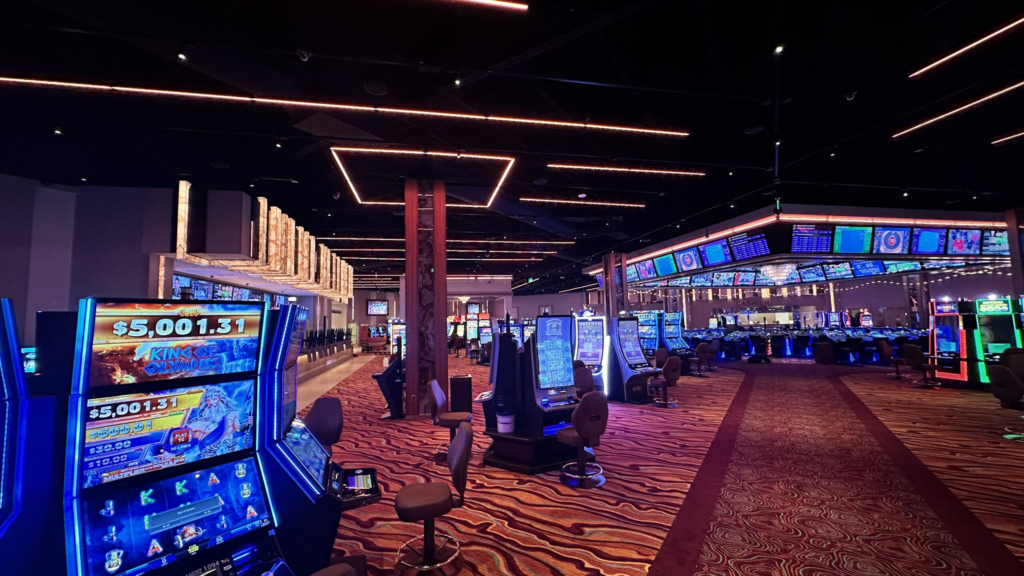
A casino floor often contains hundreds of machines and tables running simultaneously. Each game contributes a small mathematical advantage to the house.
Short Sessions Can Feel Very Lucky
One reason many players misunderstand casino odds is that short gaming sessions can produce surprising results.
In a short period, anything can happen. A player might:
- Win several hands of blackjack in a row
- Hit a slot machine bonus
- Double their starting balance quickly
These experiences feel exciting and memorable.
But randomness naturally creates streaks.
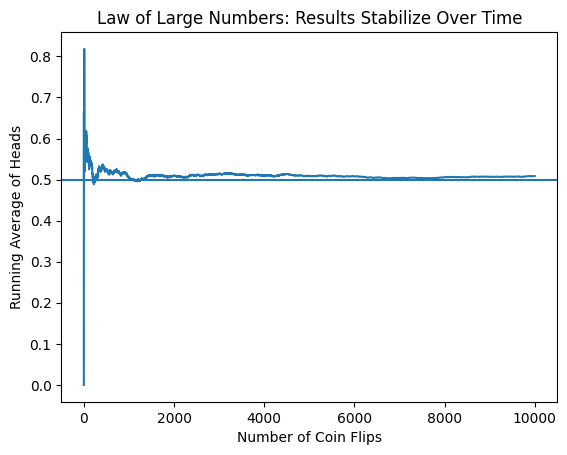
A good example is flipping a coin. If you flip a coin only five times, it is possible to get five heads in a row. But if you flip the same coin 10,000 times, the results will usually be close to 50 percent heads and 50 percent tails.
Casino games work in a similar way.
During short sessions, luck can overpower the underlying probabilities. But as the number of rounds increases, the outcomes slowly begin to reflect the mathematical expectations built into the game.
The Law of Large Numbers
A major reason casinos win over time comes from a principle in probability called the Law of Large Numbers.
This rule states that as an experiment repeats many times, the average result will move closer to the expected value.
In simple terms:
The more times a game is played, the more likely the results match the mathematical probabilities.
For casinos, this is extremely powerful.
A casino may run:
- Thousands of slot machine spins per hour
- Hundreds of blackjack hands per table each hour
- Millions of online bets every day
With so many repeated events, the expected house advantage becomes very reliable.
Statistic
Industry estimates suggest that large casinos process millions of wagers per day, especially when including online gambling platforms. Even a 1–2 percent advantage across millions of bets can generate massive revenue.
Why Casinos Encourage Longer Play
Casinos understand that time works in their favor.
Because the house edge applies to every round, the longer players continue playing, the more opportunities that advantage has to appear.
That is one reason casino environments are carefully designed.
Casinos often include:
- Comfortable seating
- Free drinks or snacks
- Bright lights and music
- No clocks or windows
These features help create a relaxed environment where players feel comfortable staying longer.
A former casino executive once explained the idea simply:
“Casinos don’t need to beat players quickly. They just need players to keep playing.”
The longer the session lasts, the more rounds occur, and the more the house edge can influence results.
What Real Players Say About Long Sessions
Many experienced gamblers eventually notice how longer sessions affect their results.
Some players share similar observations online:
“I’ve had nights where I doubled my money in an hour, but if I stayed longer I usually gave it back.”
Another player commented:
“The casino isn’t trying to beat you in one spin. They’re letting the math work over time.”
These comments highlight something many players learn through experience. Early wins can happen, but continued play often erodes those gains.
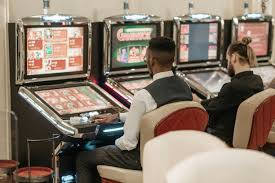
Slot machines generate thousands of spins every day, each one contributing a small advantage to the casino.
Why Small Edges Become Powerful
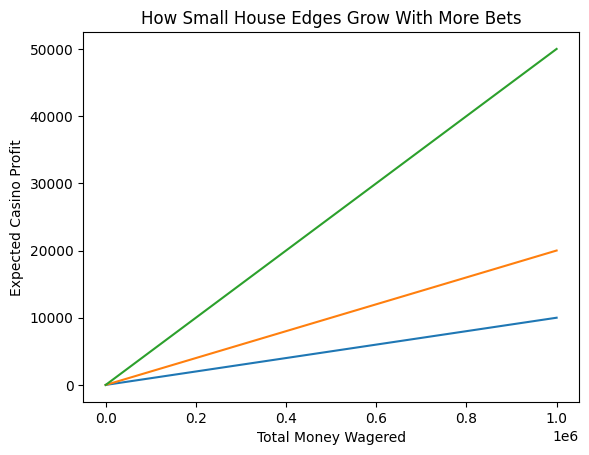
Even a tiny advantage can grow dramatically with repetition.
Imagine a casino game with a 1 percent house edge.
If players wager:
- $10,000 total → casino expects $100 profit
- $1,000,000 total → casino expects $10,000 profit
- $100,000,000 total → casino expects $1,000,000 profit
And in large casinos, these amounts are not unusual.
This explains why casinos do not rely on single big wins or losses. Instead, they rely on steady statistical averages.
Can Players Still Win?
Yes. Players absolutely can win.
Short-term results are unpredictable, and luck can favor players during individual sessions. That is why casinos regularly pay jackpots and large prizes.
Some players even leave with significant profits.
However, the key difference is time horizon.
- Short sessions: luck can dominate
- Long sessions: probabilities dominate
This is why many experienced players set limits on time or money spent during gambling sessions.
The Psychology Behind Casino Play
Casinos also benefit from human psychology.
Several psychological factors encourage continued play:
Near misses
Slot machines often produce results that appear very close to winning.
Winning streaks
Players may feel they are “on a roll.”
Loss chasing
Players sometimes continue playing to recover earlier losses.
Behavioral researchers studying gambling have found that these psychological effects can encourage players to stay longer, increasing the number of bets placed.
And every additional bet gives the house edge another opportunity to operate.
The Simple Truth Behind Casino Success
Casinos do not rely on luck to make money.
Instead, they rely on mathematics, repetition, and time.
Each individual game includes a small statistical advantage. That advantage may seem invisible during short sessions, but it becomes increasingly powerful as the number of rounds grows.
This is why casinos can pay winners every day while still generating consistent profits year after year.
Players may experience thrilling victories along the way. Some will even leave with impressive winnings.
But the longer the games continue, the more the quiet mathematics of probability begins to guide the results.
And in the world of casino gaming, time is often the house’s greatest ally.